Introduction
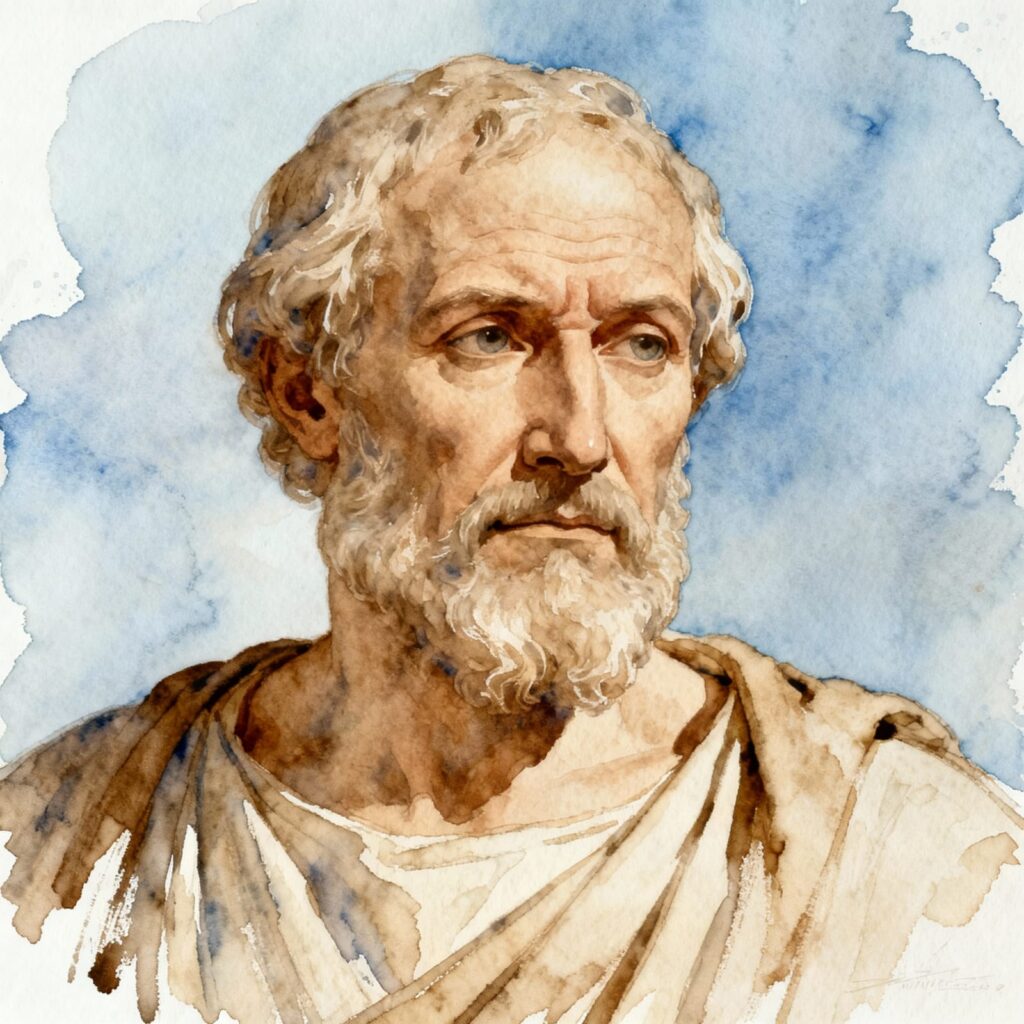
Plato (427–347 BCE) remains one of the greatest political philosophers in history and a towering figure of Western thought. His ideas form the bedrock of political philosophy, moral theory, and epistemology. A disciple of Socrates and teacher of Aristotle, Plato was deeply concerned with the question of how human society could achieve justice and harmony. His political philosophy—most famously presented in The Republic—is an attempt to define the just state and the just individual.
For Plato, politics was not merely about power or governance; it was an ethical enterprise rooted in the pursuit of truth and the realization of the “Good.” His political thought is idealistic, moral, and deeply philosophical—an effort to connect ethics, metaphysics, and politics into one coherent vision.
Plato: Life and Context
Plato was born into an aristocratic Athenian family during a period of political turmoil in Greece. He lived through the Peloponnesian War (431–404 BCE), the fall of Athens, and the execution of his mentor Socrates in 399 BCE. These experiences profoundly shaped his disillusionment with Athenian democracy and his desire to search for a more rational and just political order.
Plato’s experiences with the instability and corruption of Athenian politics convinced him that politics based merely on opinion (doxa) rather than knowledge (episteme) would always lead to injustice. His works—especially The Republic, The Statesman, and The Laws—reflect his enduring quest to reconcile human desires with rational order.
Plato’s Political Idealism
Plato’s political philosophy is built on his theory of idealism, which holds that the world we perceive through our senses is not the true reality but only a shadow of the ideal, eternal forms that exist in a higher realm. Among these Forms, the Form of the Good is supreme, representing the ultimate source of truth, justice, and order.
In the political domain, this translates into the belief that the ideal state must be modeled after these eternal truths. The goal of politics, therefore, is to reflect the cosmic order in human society. Just as reason governs the soul, so must philosopher-kings—those who know the truth—govern the state.
Influences on Plato’s Political Thought
Plato’s philosophy did not emerge in isolation. It was shaped by multiple intellectual, moral, and political influences. Understanding these influences helps us appreciate the depth and originality of his ideas.
1. Influence of Socrates
The most profound influence on Plato was his teacher, Socrates. Socrates’ method of questioning—known as the dialectical method or elenchus—sought to uncover the essence of moral concepts such as justice, virtue, and courage.
Socrates believed that knowledge and virtue were inseparable: to know the good is to do the good. His emphasis on ethical inquiry and rational argument deeply inspired Plato’s conviction that political order must be based on knowledge, not opinion.
The unjust execution of Socrates by democratic Athens left a deep scar on Plato’s mind, making him skeptical of democracy and its reliance on the ignorance of the masses. Hence, Plato proposed a system where only the wise and virtuous—those trained in philosophy—should rule.
2. Influence of Pythagoras
Plato was also influenced by the Pythagorean school, which emphasized mathematical harmony, the immortality of the soul, and the idea that reality has an ordered structure.
From Pythagorean philosophy, Plato derived his belief in the harmony of the soul and the structured hierarchy of the universe and society. The notion that every part of the cosmos and the state must function in harmony to achieve the good became central to his political theory.
3. Influence of Heraclitus and Parmenides
The philosophical debate between Heraclitus (who saw the world as constantly changing) and Parmenides (who saw reality as eternal and unchanging) influenced Plato’s theory of Forms.
Plato reconciled this by suggesting that the material world is indeed in constant flux, but the world of Forms—where true knowledge exists—is eternal. This distinction allowed him to argue that political life, though changeable, must strive to reflect the unchanging moral order of the Good.
4. Influence of Greek Political Experience
Plato’s political thought was also shaped by the Greek city-states, particularly Athens and Sparta.
Athens represented democracy, freedom, and individualism—but also instability and moral decay.
Sparta, on the other hand, embodied discipline, unity, and hierarchy—but at the cost of intellectual freedom.
Plato sought to combine the virtues of both systems: the order and discipline of Sparta with the intellectual richness of Athens, leading to his conception of the ideal state in The Republic.
5. Influence of the Sophists
The Sophists were itinerant teachers who emphasized rhetoric, relativism, and the belief that “man is the measure of all things.” Plato rejected their relativism and moral subjectivism.
He argued instead that truth and justice are objective and absolute, discoverable through reason. His opposition to Sophism strengthened his belief that political rule must be grounded in knowledge of the Good, not in the manipulation of opinion.
Plato’s Political Philosophy: The Ideal State
In The Republic, Plato presents his vision of the ideal state—a political system designed to achieve justice both at the individual and collective level. The state, for Plato, is a magnified reflection of the soul.
1. Tripartite Theory of the Soul and the State
Plato divides the human soul into three parts:
Reason (love of wisdom)
Spirit (love of honor)
Appetite (love of pleasure and material needs)
Correspondingly, the state has three classes:
Rulers (philosophers) – guided by reason
Auxiliaries (soldiers) – driven by courage and spirit
Producers (farmers, artisans, traders) – motivated by appetite
Justice, according to Plato, exists when each part performs its proper function without interfering in the roles of others. Similarly, the state is just when every class fulfills its duty in harmony.
2. The Philosopher-King
Plato’s most enduring political concept is that of the Philosopher-King—a ruler who possesses both wisdom and virtue. Only those who truly know what is good for the entire community, he argued, are fit to govern.
Philosophers, having transcended the illusions of the material world and understood the realm of Forms, are uniquely qualified to rule in accordance with truth and justice. Thus, knowledge of the Idea of the Good becomes the foundation of political authority.
Plato’s Idea of the Good
The Idea of the Good (Form of the Good) is the highest and most fundamental concept in Plato’s philosophy. It represents the ultimate reality—the source of truth, order, and existence itself.
In the Allegory of the Cave (Book VII of The Republic), Plato describes prisoners who see only shadows of objects on a cave wall, mistaking them for reality. When one prisoner escapes and sees the sun, he realizes that the sun (the Good) illuminates all truth and knowledge.
Similarly, the philosopher ascends from the world of appearances to the realm of true knowledge, guided by the Idea of the Good.
Characteristics of the Idea of the Good:
1. Supreme Form: The Good is the highest of all Forms; it gives being and intelligibility to everything else.
2. Source of Truth: Just as the sun enables sight, the Good enables knowledge.
3. Moral Standard: The Good is the ultimate standard of justice, virtue, and morality.
4. Political Principle: The ideal state must be organized according to the knowledge of the Good; only then can justice prevail.
Thus, for Plato, politics is not a struggle for power but a moral enterprise aimed at realizing the Good in human society.
Criticism of Plato’s Political Thought
While Plato’s idealism has inspired centuries of thinkers, it has also faced criticism.
1. Authoritarianism: Critics like Karl Popper argue that Plato’s vision of a hierarchical, rigid state paves the way for totalitarianism.
2. Utopianism: Plato’s ideal state is seen as impractical and detached from human realities.
3. Neglect of Individual Freedom: The subordination of individuals to the state’s goals limits personal liberty.
4. Static Social Order: The rigid class structure discourages social mobility and change.
Despite these criticisms, Plato’s ideas continue to provoke discussion on justice, governance, and the moral foundations of politics.
Relevance of Plato’s Political Thought Today
Plato’s political philosophy remains profoundly relevant in modern times. His insistence that politics must serve ethical ends continues to inspire debates on governance, leadership, and justice.
His Philosopher-King concept resonates with modern calls for educated, moral leadership.
His critique of democracy warns against populism and uninformed decision-making.
His Idea of the Good reminds us that politics, at its best, must aim at moral and collective well-being, not mere power.
Even today, Plato’s vision challenges societies to align their political systems with truth, wisdom, and justice.
Conclusion
Plato stands as the founder of political philosophy, whose ideas continue to illuminate the moral dimensions of political life. Deeply influenced by Socrates, Pythagoras, and the tumultuous politics of Athens, he created a timeless vision of an ideal state governed by knowledge and virtue.
His concept of the Idea of the Good—as the ultimate source of truth and justice—forms the ethical foundation of his political thought. Though his system has been criticized as utopian, Plato’s enduring message is clear: politics is not merely the art of power but the pursuit of the Good.
In an age of moral and political uncertainty, Plato’s vision reminds us that true governance must always begin with wisdom and end with justice.